Alone Beneath the Burning Sky (or Connecting Your Way)
By Jonathan DeGroote

I do not know whether the Maasai blessing I received during the naming ceremony the day before did something mystical, or whether my body simply ran out of ways to stay awake, but last night the impossible happened: I got a full 8 hours of sleep.
I woke before the others and took a shower, grateful for the small mercy of feeling clean and rested again. After getting ready, we headed out on a short morning game drive, where we spotted six or so hippos resting in shallow water, their backs and heads barely breaking the surface like dark stones in the morning light. I looked at one. Then it looked at me. Its eyes sat high on its head like two judgmental marbles barely above the surface, staring back with the ancient irritation of something that had absolutely no interest in making new friends. The creature looked like it had spent thousands of years perfecting the art of being left alone.
Hippos remind me a lot of myself before I’ve had my morning cup of coffee: suspicious, half-awake, and deeply offended by the existence of other people.
After the drive, we were treated to a surprise breakfast out in the bush. I finished my food
quickly and found myself not feeling very social. Nothing was wrong exactly. I just needed a few minutes away from the group, from the talking, the movement, and the constant work of taking everything in.
Nearby, I spotted a fire pit. We were not planning on having a fire, but something pulled me over. I gathered a few sticks, hunkered down beside it, and arranged them carefully, trying to build what I hoped would be a good fire for whoever came after us.
I liked the idea of that. Building something I would never get to use. Leaving behind a small act of care for someone I would never meet. Maybe no one will ever use that fire. Maybe the wind scattered it before the next person arrived. But for a few minutes, it felt good to leave something useful behind.
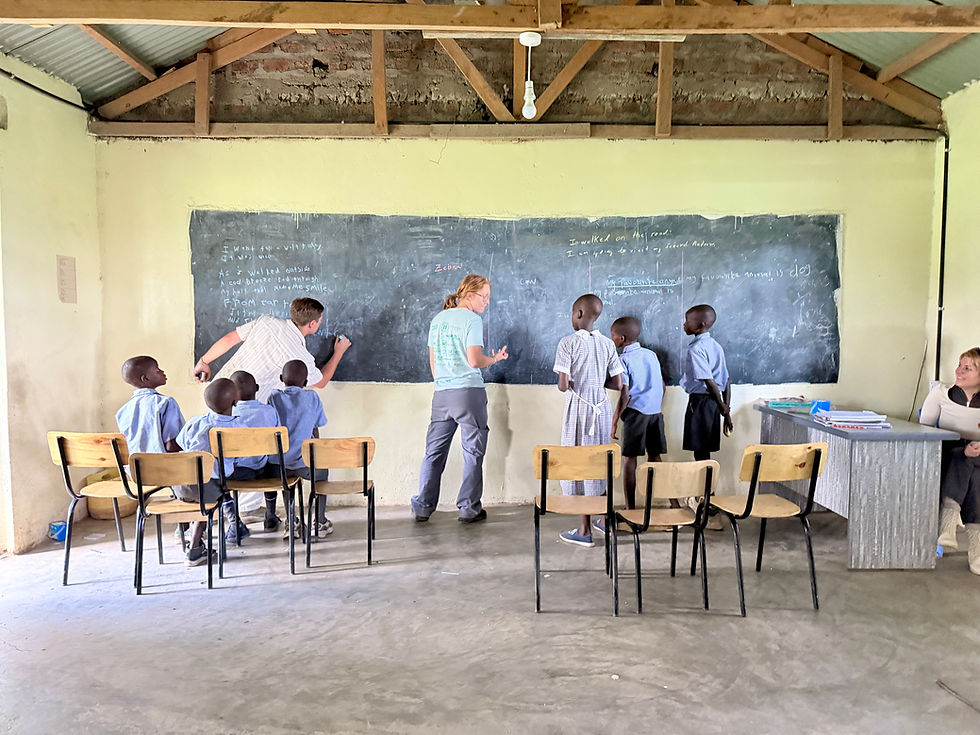
After that, we headed back to the Maasai village to teach at the school. Everyone was supposed to share something connected to their field of study. I am a social work student, so naturally I ended up teaching English writing.
My plan was simple. I wanted to teach imagery. I wanted to show the kids how a sentence could do more than deliver information. How “I went for a walk outside today. It was nice” could become dust under your shoes, sunlight on your face, and the smell of rain hanging in the air.
In my head, this was going to be glorious. I pictured myself standing there like some deeply underqualified, budget version of Robin Williams from Dead Poets Society, opening young minds to the sacred powers of language and description. Reality, however, had other plans.
I was working with four kids, and as soon as I called them over, their eyes lit up. They seemed genuinely happy to see me.
It was not exactly the poetic workshop I had pictured, but maybe that was the beauty of it. Things got lost in translation in little ways, and my neat little lesson had to become something more flexible. I had to replan, improvise, and pay attention to what was actually happening instead of what I had imagined would happen. What was supposed to be a lesson on imagery became one kid drawing an animal while the others described it with whatever words they had.
The lesson became less about crafting beautiful sentences and more about finding a way to connect. Connection does not always come from getting the lesson right. Sometimes it comes from letting the plan fall apart and finding something more honest underneath it. I met those kids where they were, and with their smiles and excitement, they met me where I was too.
After the lesson, we split off in different directions. Once again, I drifted away from the other students, but this time I ended up playing soccer with some of the kids. Here’s the thing about that: I generally do not like kids. They are messy, annoying, needy, emotionally immature, and so am I. I can only handle one of me at a time, so children are not usually my favorite. But playing soccer with those boys became one of the best experiences I had the entire trip.
At first, soccer was easy. I stood as goalie and only had to block one ball. I thought, falsely, that I had discovered my athletic destiny. Maybe all those years of running had led me to this exact field in a Maasai village, protecting a goal from a group of small children.
Then one ball somehow became three. Suddenly, I was sweating, jumping, and spinning in every direction. Balls were flying at me from all sides. I had no idea what the rules were anymore, or if there had ever been rules to begin with. It was chaos, but the kind that makes you feel fully awake. I probably looked ridiculous out there, twisting my body into unnatural shapes and trying to keep up with them. But I was laughing too hard to care.
At one point, I picked a small white flower and put it behind my ear. One of the kids wanted to copy me, so he put one behind his ear too. Then the others noticed.
They started gathering flowers and handing them to me. Soon I had a tiny bouquet of little white flowers in my hands, and they all wanted me to place flowers behind their ears too. It caught me off guard. It was such a small thing: children laughing in the sun with flowers tucked behind their ears. But there was a tenderness to it I was not prepared for. For a little while, it did not matter that we came from different countries, spoke different first languages, or would probably never see each other again. They were not asking for much. They just wanted me there with them, part of this
strange, ridiculous, beautiful little world we had created together. And that is how we became the White Flower Brigade.
For a while, I forgot I was tired. I forgot I was socially drained. I forgot I was a visitor in a place I barely understood. I was just there, laughing with these kids, putting flowers behind their ears, and watching their faces light up when I got it right. Some memories do not feel important while they are happening. They arrive disguised as ordinary minutes, then follow you home.
Years from now, when I think back on this trip, I will probably forget the exact order of the day, what we ate, or who I rode with, but I will always remember the flowers, the laughter, and the strange joy of discovering a kind of happiness I never expected to find with a group of children. I was truly sad when it was time for us to regroup and go to the market in the women’s village. The day moved on before I was ready for the moment to be over.
I left the White Flower Brigade behind and wandered back toward adult civilization, unaware that I was about to walk directly into a full-scale sensory assault. The second I stepped into the market, I was ambushed from every direction.
“Come, come, buy something”
“Here, my friend!”
“Come look!”
Voices crashed into me from all sides. Every stall had something colorful, handmade, beautiful, and every woman seemed determined to make sure I saw it before I escaped. Beaded necklaces flashed in the sunlight. Bright fabrics swayed in the wind. Hands pointed. Smiles appeared. Prices were quoted. My brain, already running on a dangerous mixture of excitement, social exhaustion, and safari dust, began to short-circuit. I had no money to spend. Everything was beautiful. Everything deserved attention. And my poor, overworked brain was trying desperately to process all of it at the same time. So I went back to where the safari vehicles were parked.
I found a small clearing near the vehicles and sat there alone. In the distance, zebras, gazelles, and wildebeest moved together across the open land, as if following some old road only they could see. A cool wind passed over the grass, carrying with it the faint laughter of children somewhere behind me.
I could not have said how long I remained there. The light had begun to soften, and the day was slowly giving itself over to dusk.
Far out on the plain, a lone wildebeest stood beneath the burning sky. Evening light wrapped around it until the animal looked half real, half shadow. The soil glowed red-gold, and dust moved over the plain in ember-colored veils. For a moment, the whole world seemed to n arrow around that single figure, standing alone while everything around it blurred into heat, dust and fading light.

The other animals had long since disappeared into the evening haze, but this one remained. The wildebeest walked slowly, without fear or urgency, in the opposite direction of everything else. It was not loneliness exactly. It was solitude with a purpose, the kind of distance you take not because you are lost but because you are trying to find your way back to yourself.
I was not trying to escape anyone. It was grateful for all of it: the people, the place, the culture, the impossible privilege of being there at all. But out there, watching the sun burn itself down behind that solitary figure, I felt more at peace than I had for years.
The herd was never the problem.
I was just tired from taking in so much at once: the movement, the voices, the beauty, the feeling of it all. I needed to step away long enough to remember myself. To let my thoughts catch up with my body. To feel like I belonged to my own life again.
The wildebeest eventually disappeared into the haze.
Behind me, I could hear the others gathering near the vehicles. The sun was nearly gone.
For a few more seconds, I let myself belong only to the wind, the dust, and the dying light. Then I rose, brushed the dust from my pants, and walked back.
The author was a participant in a May 2026 Northwestern Michigan College trip to Kenya, organized and led by Uplift Travel in conjunction with ground handlers from Capture Kenya Expeditions. This piece was an excerpt from his trip journal.


Thank you for this. Thank a piece of writing is truly a gift at a time most needed.